Showing posts with label homemade. Show all posts

May 9, 2012

Vase rehab DIY: Blah to Yay!

I have often mention the joys of sprucing up some freebies:

*  Those oddball items you keep hanging onto but live in the depths of your closet or under your sink because you don't actually like them but feel bad about throwing them out because they're still useful.

* Thrift store or yard sale finds with potential

* Freecycle (freecycle.org) freebies

I have acquired a small collection of glass vases from Freecycle.  My husband's Urban Garden Paradise includes a wildflower cutting planter box, so in preparation for some fresh cut bouquets, I have been seeking out some containers.  I also have decided faux flowers are not necessarily relegated to the status of Mrs. Havisham, and can be done in style with punchy colors or romantically with vintage hues.  I've worked in both styles to various rooms:  vivid and playful daisies in the living room, and soft and romantic classics in the bedroom.

So my vase collection necessarily needs to grow from 1-2 to several.  But who wants to spend money on vases when they're so abundantly found second hand for free or cheap?  That's not to say I appreciate the style of those castoffs, so that's where a little creativity comes into play.  I've been itching to try some new techniques and rehab these either blah or dated vases, and here is my first endeavor.

Perfect for faux flowers, interior-painted vases can cover up internal ripples (as in my example) and leave plenty of room for a punchy embellishment on the exterior.  Check out the easy DIY below!

Witness my plain rippled glass freebie.  I'm not a fan of rippled glass vases.  I'm sure it's appropriate somewhere, but I don't care for it.  Plus with faux flowers, often the stems are not very attractive, so a translucent vase can subtract from the decorative effect.


(Right)
1.  Pour a water-resistant paint into the vase, such as latex paint or "patio" or outdoor acrylic.  I went with a Clark and Kensington Flat Enamel Paint and Primer in One in a Mediterranean teal that I got (for free!) from Ace Hardware.  It had wonderful coverage.

2. Gently roll the vase around until the paint has covered the full interior.  Then pour the excess back into the paint can.

3.  Let the vase sit upside down over some newsprint to drain the slower excess from the interior, for about an hour or so.  Don't let it sit so long the paint starts to dry and the newsprint peels off.  If this does happen, just scratch off the paper from the rim and touch up with some of the wet excess pooling on the newsprint.

4.  Turn back over right side up, and allow to dry, several hours or overnight.

5.  (left) Once dry, add your front embellishment with "puffy" paint or fabric paint (I used Tulip fabric paint in white).  If you make a mistake, or don't like it, just wipe clean with a damp paper towel, dry the vase, and start over.

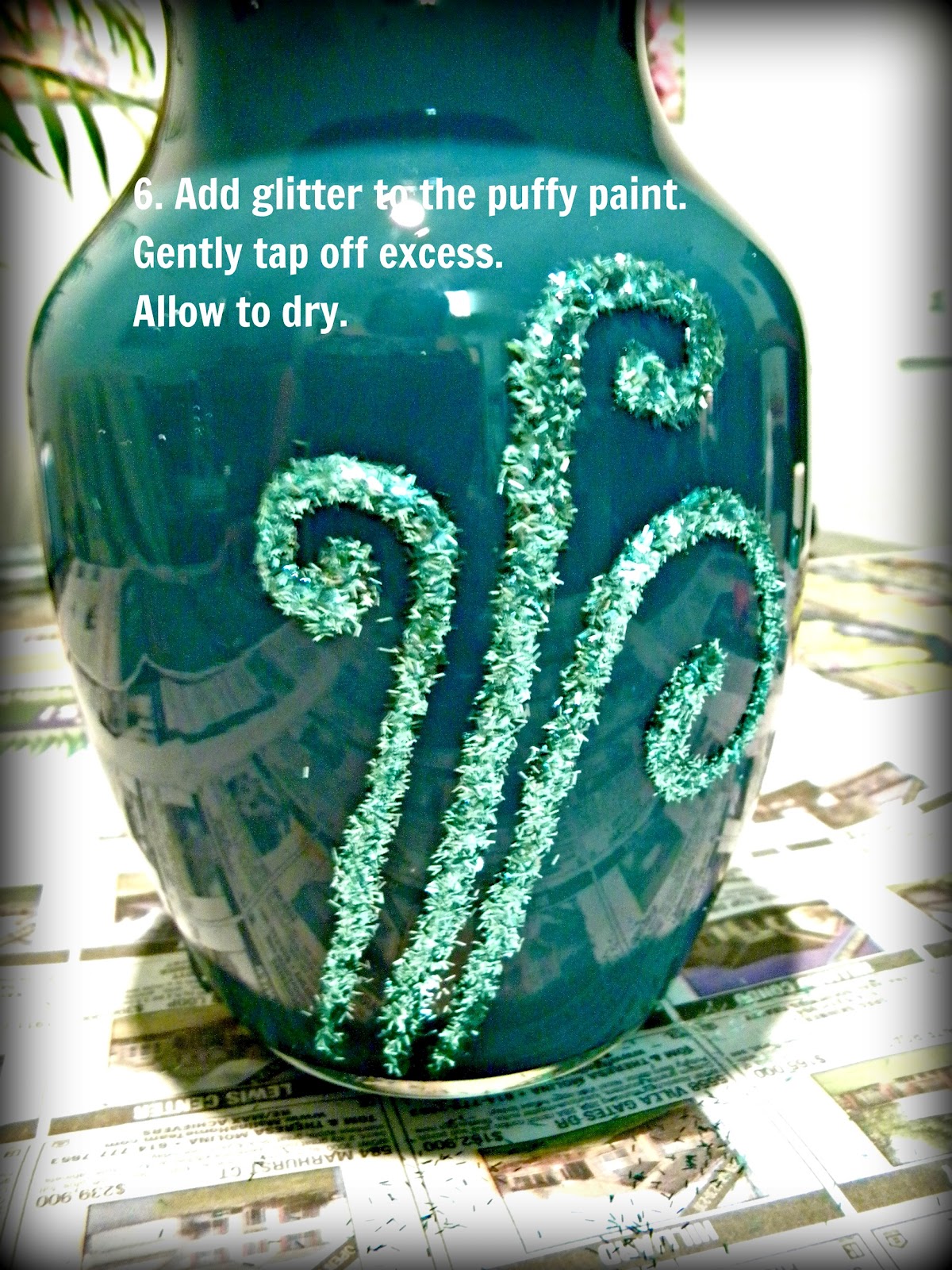
6.  Add glitter, gently tap off excess.

I started with this dot design in the puffy paint, but discovered it didn't work too well with the glitter I used.  I ended up sticking my fingers in it and disrupting several "dots" so I scrapped the whole design by wiping it off with a paper towel while it was still wet.  My simple three swirl lines (next photo) replaced it.

The glitter I used was the "tinsel" style which is little strands of flat strips of glitter instead of the regular tiny square pieces.  It has a nice, unexpected textural effect. (Martha Stewart tinsel glitter in Feldspar.)

Finally, add your flowers!  Faux flowers would work best at this stage, although you could spray the inside with a clear waterproof sealant if you wanted to be able to use fresh flowers.

Now you can see that the teal blends in with my decor!  I used a monochromatic palette but some other fun combos could be done with complementary colors such as a violet or plum interior and yellow or gold glittered exterior, or cobalt interior with orange or topaz glitter.  You could make your outer embellishment as simple or plain as desired.  Use your imagination!


January 23, 2012

A Breath of Fresh Air


The concern for the inundation of chemicals over-used in the home is growing, and for good reason.  With the average household reportedly containing an average of 62 toxic chemicals, many found in cleaning and deodorizing products, if you haven't given a thought to how much junk you're spritzing around your home, you should.

Not only do these chemicals linger around the home, but they hang out in your body as well.  Individuals have seen marked reduction in autoimmune-related disorders and symptoms by substantially reducing exposure to common household chemicals, thought to store up insidiously in the body and trigger inflammatory responses (see Sholl, 2011 for case studies).

Although small amounts of any given household chemical is not usually dangerous, most of the problematic ingredients are not regulated, have been identified as potential carcinogens, and are understudied.  Even current studies on individual additives fail to examine the effect of cumulative unintentional mixtures of these various chemicals and long term exposure.  Worse, these chemicals fall under a variety of names for the same components, making even diligent label-reading an ineffective prevention.

Commercial home fragrances can be particularly harmful because they are aerosol or at least sprayed in some form into the air, and their very purpose is to be breathed in, en route directly into our bodies via our largest and most susceptible mucous membranes--nose, mouth, lungs.

Educate yourself (see references for further reading below) and consider eliminating or at least seriously reducing your intake of these toxins.  Sure, you might feel OK now, but decades down the road? More importantly, you can't tell how they are affecting your body (or your childrens') in terms of inflammatory responses and allergies if you've always used them.

Consider trying an experimental detox of your home:  eschew commercial cleaners and air fresheners for a period of time, say at least a month, and evaluate for yourself if you experience a reduction in even mild symptoms you consider "normal" (mild but regular headaches, sinus congestion or pressure, etc).  You'll definitely save money, and you might discover you could be feeling a lot better than you are presently.

I can tell you from my experience, about six months into my near total elimination of commercial cleaners and fragrances, I have enjoyed significant reduction in upper respiratory symptoms.  I have been a life-long allergy sufferer--allergy shots in my youth, recurrent sinus and ear infections typically 3-4 times a year, and general daily sinus pain and pressure.  I consider "normal" to include anytime I can physically breathe through my nose, because a "flare up" results in complete obstruction.  I have a litany of "they're everywhere!" allergens: almost all kinds of common grasses, trees, dust mites, pollens, molds, and more.  Not much I can do here in Ohio to avoid those.  But I do know that I have NOT had a sinus infection since a month or so into my de-chemical experiment, and my overall daily symptoms have been reduced.  Sure there are confounding variables and correlation does not necessarily imply causation, but I plan to continue.

Besides, I save a boatload of money that we can spend on stuff a lot cooler than carpet or counter cleaners or  "that doesn't smell at all like 'fresh air'" home sprays.

Things you can do in a jif to spruce up your sniffer:

Open the windows, let some air circulate.  You can do this for a little bit many days even in the winter, even if it's just for 15 minutes or so.  It's 49-degrees in Ohio today, a perfect opportunity to get some fresh air in the house, because two days from now it's going to be in the 20's.

Find the source of the odor. Maybe you just need to take the trash out more often, wash the dishes or wash some blankets.

Simmer some aromatics.  Throw the peels from citrus fruit you use in a pot on the stove and toss in some complementary herbs, simmer on low for awhile.  Try clove-cinnamon-anise or lemongrass-bayleaf-basil, for example.  When I eat oranges, for instance, I put the peel in a pot on the stove and boil then simmer in plain water which both smells wonderful and serves a second purpose.   Doing so extracts the orange oil from the peel into the water, which I will then mix with vinegar.  Orange-oil infused vinegar makes an excellent all-purpose cleaner and de-greaser. I just strain and pour the orange-vinegar-water mix  into an empty gallon-sized jug and add to it every time I make a batch.  Never waste an orange peel = never run out of all-purpose cleaner.

Make your own sprays.  If you need the occasional quick-fix, make your own home fragrance.  All you need is a clear alcohol (grab a $4 bottle of cheap vodka, for example, which I greatly prefer to using isopropyl), some essential oils (which have 101 uses in the home, look 'em up), some dried herbs (optional) and cool, clean water.  See the recipe below for an example.

References and Further Reading:

Sholl, Jessie (2011) Eight hidden toxins: What's lurking in your cleaning products.  Experience Living. October, 2011.  http://experiencelife.com/article/8-hidden-toxins-whats-lurking-in-your-cleaning-products/


 Weil, Andrew (2008) Air fresheners: Are they bad for my Heath? by Andrew Weil, M.D, Prevention,October 2008.  

Also stop by http://www.silentmenace.com/-Air_Fresheners_.html for an editorial, with additional sources.

A Breath of Fresh Air: Home Spray Recipe:


To a spray bottle, add:


Equal parts vodka and water
Cedar essential oil
Rosemary essential oil, or dried rosemary if large enough not to get sucked up spray hose, which will obstruct it.  If using dried, you probably won't be able to smell it right away, until the herbs "cure" in the vodka for a few days.
Clear vanilla extract


Add essential oils in whatever concentration pleases you.  Add a little, shake, smell: you can always add more, but if you over-power you will have to dilute with more vodka/water.  


Shake before use, and spray into the air; avoid spraying directly onto delicate fabrics such as silk, or directly onto surfaces such as unfinished wood or wallpaper.  Use your common sense, don't drink it, obviously.  


Image Credits: aluminum spray bottle, Eco Nuts $3.99; Cedar tree identification photo, BorealForest.org; Vanilla beans,The Epicenter Encyclopedia of Spices; Smirnoff vodka, Smirnoff brand; Rosemary, Wikipedia entry.

October 7, 2011

Living in an Amish-ish Paradise, (part one in a series on frugality and consumerism)

That Weird Al nod started my Facebook post yesterday in which I couldn't help but exclaim the awesomeness of an age-old homemade laundry detergent recipe I found.  With 15 minutes of effort and $1.71-worth of deliciously cheap, natural, raw materials I whipped up 5 gallons of a sparkly-clean-scented liquid laundry detergent good for 320 regular loads.  The Look-What-I-Made high from this endeavor propelled me on a trek through the blogosphere to glean what other consumer household products could be replaced with these cost-effective, natural, homemade solutions.

Turns out there's an entire community based around the principles of make-your-own and do-it-yourself that goes far beyond home decorating and flea-market refurbishes.  Now the concept of taking homemade to a whole new level has been exiting to me since I first discovered that homemade bread was, in fact, perfectly do-able.  Yes, any new endeavor requires some experimentation and skill-building, and just as I'm a better cook & baker now than I was 5 years ago, so it goes with all new projects.  Overcoming a lack of inertia, rolling up your sleeves and getting dirty (sometimes literally) in the quest for the Next Cool Thing to Learn to Do, is a regular occurrence.  You just have to get started.  And you have to learn to take failures in stride.  Not every new recipe, jewelry-making or sewing technique, art project (or parenting trick!) will work--and failures will run the gamut from Not What I Was Hoping For to Colossal Fail.  Heavy sigh.  Clean it up.  Move On.

So with this in mind I'm perfectly willing to have a go at whipping up some homemade bath & body products like shampoos, body washes, soaps, lotions, and replacing commercial cleaners & detergents with homemade, natural (and cheaper!) concoctions.  But what I've found most interesting is the various motivations behind different individuals' choice to pursue a homemade lifestyle.

There are various reasons to eschew many consumer goods for DIY alternatives: financial, health & safety, concern for the environmental impact of these products, and rejection of consumerism & a disposable lifestyle in general.  Reading individuals' arguments for these various perspectives has prompted me to examine my own ideas on these hefty  issues and how they fit in (or help shape) my overall life philosophy.

My first encounter with going homemade was driven by wholly creative pursuits.  From an early age I've been compelled to create, to make, to tinker.  I love the process of transforming things from their raw materials, full of potential energy, to their kinetic apex.  The process is a cathartic form of self-expression and an exercise in self-confidence that comes from making something with my own hands.  This has lead me to pursue (albeit slowly) a creative entrepreneurship as well as expand my repertoire of Things I Can Do in life in general.

These days, under the pressures of this recession, money (more specifically, money problems) is on the forefront of many peoples' minds.  Many people are hurting.  People who aren't yet hurting are anxious they might.  Some people, of course, are confident that they will be perfectly fine and not have had to make many or any changes to their lifestyle.  We are not those people.  My friends are not those people.  In fact, I don't personally know too many of those people.

Because of this, financial reasons have driven me to examine ways to shave off non-essentials and replacing pricey (yet often inferior quality) consumer goods with natural homemade alternatives.   With our alternating job losses, this makes the second year of being pretty darn poor, worse, pretty darn poor with a kid (or because of the kid).  With the cavernous gap between the infinite list of Things I Wish We Could Buy or Do (is anybody's list finite?) and the instability of income from work, part time work, and the family business--the reality is more like some weeks (or months) finding an extra $20-$40 for a fresh hair cut is just as much on the Not Gonna Happen list as finding $20-$40,000 for a new car.

Just as economic analysts and media pundits have suggested, it's just another example of the "new reality" of an economic condition that's probably going to be around much longer than we'd like to think. For us, our New Reality means we can't get away with superfluous expenditures like eating out for dinner frequently, going to full-price movies, stopping every morning for (a shamefully unhealthy) breakfast & coffee, mindlessly plucking every whim off the grocery shelves, recreational shopping, and more.  How's your New Reality looking?

The first step in overcoming that jarring "this sucks" reaction is making peace with your New Reality. You can either wallow in the craptasticness of the situation, lamenting the new restrictions on your consumption, insisting that you'll never experience fun again--OR you can suck it up and adapt.  After a brief period of mourning of course, we've decided to push on towards the latter.  And we're not alone.  The people I hang out with the most are in similar situations, and there's no need to feel judged or insecure about being frugal and thrifty in order to adapt to New Reality.  If you're in this boat, know that a lot of people you encounter during your daily life are too.

Now our New Reality looks more like state and metro park trips, dusting off the board games (or brushing up on Rock Band) and dining with friends at the dinner table instead of noshing at a restaurant, hitting the library instead of Barnes & Noble, brewing coffee instead of buying, shopping planned trips to Aldis instead of getting whatever looks good at the moment at grocery stores, thrift-store perusing (call it Goodwill Hunting, it will make you smile) instead of the mall, seeing movies at the dollar theater and smuggling in snacks instead of forking out the cash for the new-releases, mending,  refreshening,  or refurbishing clothes and other goods instead of tossing them at the first minor defect or from boredom, cooking more at home, making pitchers of teas & lemonades instead of buying beverages, and more.  Baby steps, my friend, and we've come a long way towards happily existing within our means even when those means shrink.

The good news is that making the most of doing with less is ripe with creative potential, which has been a great coping mechanism for me.  I'm learning to look around at things in a new way--looking for ways to breathe life into old things so they feel just as exciting as if I had ditched them for the Next Cool Thing the store display, TV, or magazines told me I wanted.  The next exiting discovery--the potential of homemade household goods which can be whipped up to my specifications with my own two hands out of natural, good-smelling, toxin-free raw materials for less than commercial alternative and with far greater satisfaction.

Bring it on.